
Views: 0 Author: Site Editor Publish Time: 2026-04-01 Origin: Site


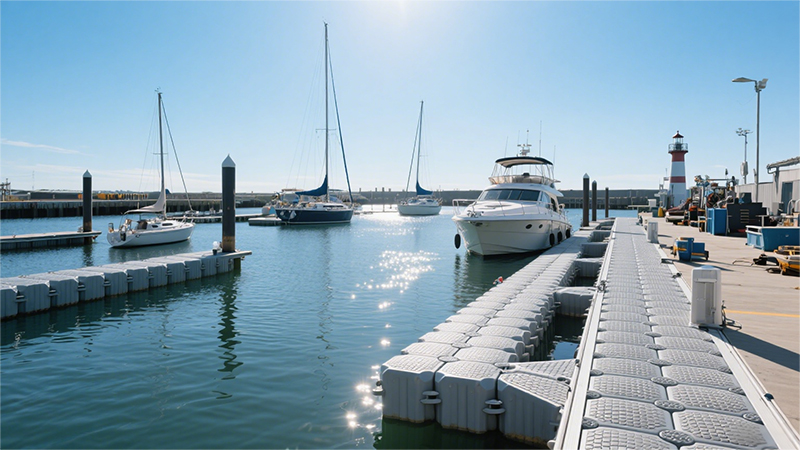
You can trust a floating pontoon if you set it up right and take care of it. Its floating power and steady shape help keep you safe, even when the water goes up or down. Many people like aluminum floating pontoon or concrete floating pontoon because these materials do not break easily in bad weather. You are less likely to trip than on fixed docks, and you get safer ways to get on boats or swim. Floating docks move with storms and water, so people get hurt less often. Always look at the water before you jump in so you do not get hurt by things you cannot see.
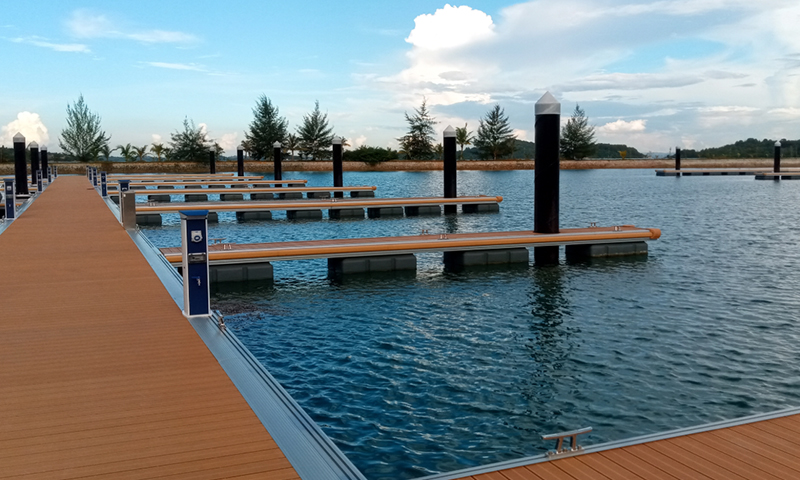
Floating pontoons stay steady and safe. They move up and down with water. This helps stop accidents from happening.
Pick pontoons made from strong materials like polyethylene or HDPE. These last longer and need less fixing.
Check your pontoon often to keep it safe. Look at it every month and after storms.
Non-slip surfaces and safety rails make pontoons safer. They help everyone use them, even people with disabilities.
Floating pontoons can make your property worth more money. They are a good choice for homes near water.
A floating pontoon stays steady, even if there are waves or the water rises. Its design uses buoyancy to keep it above water. One cubic meter can hold up about 1,000 kilograms. This gives you a strong place to walk, fish, or get on a boat.
Safety rules help make sure floating pontoons are stable. Makers follow certifications like CE to meet these rules. You can see some types in the table below:
Pontoon Type | Compliance | Characteristics |
|---|---|---|
Type A | CE | Made for certain marine uses |
Type B | CE | Works for many different needs |
You should know about stability numbers. The metacentric height (GM) should be more than 0.5 meters. The heel angle with a full load is less than 5 degrees. After loading, freeboard is at least 250 millimeters for HDPE pontoons and 500 millimeters for MS pontoons. These numbers show floating pontoons can handle groups and rough water.
Modular designs make floating pontoons safer for boating, fishing, and swimming. You can connect pieces to make a bigger platform. This lets you change the size and shape for what you need. You get a steady place to fish or relax with friends. Floating pontoons lower the chance of accidents when many people use them.
You want a safe place to step on a floating pontoon. Designers use non-slip decks to stop slips, even when wet. Wide, low designs help the pontoon not tip over. Safety rails protect you in deep or open water.
Here is a table with features that help prevent accidents:
Design Feature | Benefit |
|---|---|
Non-slip deck surfaces | Stops slips, even when wet |
Wide low-center-of-gravity designs | Helps keep the pontoon steady |
Safety rails | Important for safety in deep or open water |
There are fewer tripping dangers than on fixed docks. The floating pontoon moves with the water, so you do not face sudden steps. Modular parts fit together smoothly, so you do not trip on uneven boards.
Non-slip decks keep you safe when it rains.
Safety rails give extra safety in deep water.
Smooth joints between parts lower tripping risks.
You want your floating pontoon to last a long time. Makers use materials like polyethylene (PE), steel, HDPE, and PVC. Each material has special benefits for lasting longer and easy care.
Parameter | Polyethylene (PE) Pontoon | Steel Pontoon | Contribution to Durability and Use Case |
|---|---|---|---|
Self-weight (kg/m³) | Light (~950) | Heavy (~7850) | PE is easy to install; steel holds heavy loads |
Salt spray resistance | Up to 20 years | 8-10 years | PE resists rust better, so it lasts longer in salt water |
Ultimate load capacity (ton/m²) | 1.2 | 3.5 | Steel can hold more weight |
Maintenance frequency | Every 5 years | Every 2 years | PE needs less care, so it costs less over time |
PE pontoons have hollow parts that can be filled with foam. This makes them more stable and stops rust. Steel pontoons can be welded and made stronger for tough places. HDPE and PVC do not get hot easily and block UV rays, so they last longer. Both PE and steel pontoons can be recycled, which helps the planet.
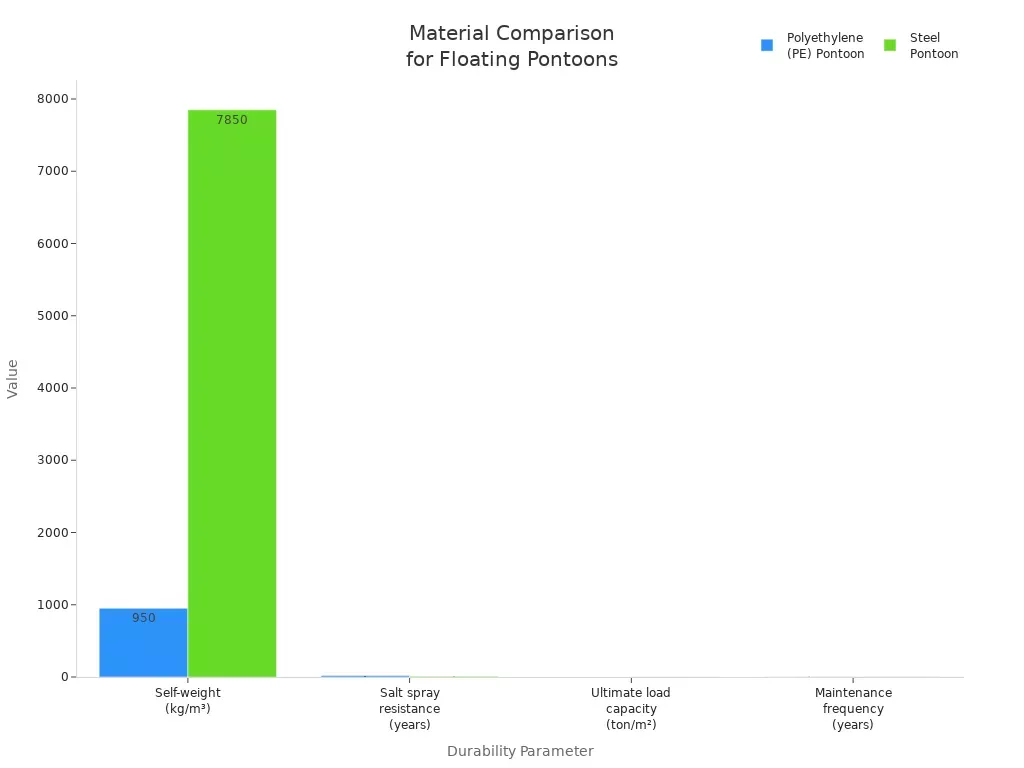
You spend less time fixing a floating pontoon. PE pontoons need checks every five years. Steel pontoons need checks every two years. You get a platform that stands up to salt, heavy things, and sun.
You need a dock that is safe when water changes. A floating pontoon goes up and down with the water. You step onto it at the same height every time. Fixed docks can get too high or go underwater in floods. This makes it hard to use and can cause accidents.
Here is a table to compare:
Feature | Floating Pontoons | Fixed Docks |
|---|---|---|
Adaptability to Water Levels | Stay at the same height as water | Can be too high or underwater, making it hard to use |
Safety | No gaps or uneven spots, so fewer accidents | Uneven spots and gaps, so more accidents |
Structural Integrity | Flexible, handles changes in water | Can break from changing water levels |
Floating pontoons are safer where water rises and falls a lot. Their flexible design stops damage and keeps you safe.
You want a dock everyone can use, even people with disabilities. Floating pontoons are made to be safe and easy for all. They follow ADA rules. Makers try to meet accessibility standards.
Floating pontoons stay level with the water.
Ramps and handrails help wheelchairs and strollers.
The surface stays smooth, even when water moves.
Fixed docks can be hard to use when water changes. You might see big steps or gaps that make it tough for some people.
You want your dock to last and stay safe. Floating pontoons need checks, but you spend less time fixing them than fixed docks. Here are some tips:
Check your floating pontoon every month and after storms.
Patch small cracks with marine-grade epoxy.
Clean the surface to stop slips.
Make sure bolts and floats are tight and level.
Fixed docks need more work:
Pressure wash to stop rot and mildew.
Sand wood to prevent splinters.
Watch for rust and algae.
Add rub rails to protect from boats.
Apply stains and finishes each season.
Manage ice in winter to stop damage.
You take floating pontoons out of the water in winter to protect them from ice. Fixed docks stay in place, but need extra care in cold months.
You face different risks when you use a floating pontoon. Weather can change quickly. Storms, floods, and strong winds can make the water dangerous. You should know what can happen during bad weather. The table below shows common risks and what they mean for you:
Risk Type | Description |
|---|---|
High Water Surges | Water can rise fast and lift boats or cover docks. |
Strong Winds | Winds can blow things away or damage your pontoon. |
Heavy Rains | Rain makes surfaces slippery and can flood boats. |
Unsecured Vessels | Boats can drift or crash into docks if not tied well. |
Electrical Hazards | Broken wires or power lines near water can shock you. |
Environmental Contamination | Storms can spill oil or chemicals into the water. |
Tornado Formation | Hurricanes can cause tornadoes with very strong winds. |
Water Quality Issues | Storms stir up dirt and germs, making water unsafe for swimming. |
You should always check the weather before you go to your dock. If you see a storm coming, stay off the pontoon and move boats to a safe place.
You keep your floating pontoon safe by checking it often. Regular maintenance helps you find problems before they cause accidents. Here are steps you should follow:
Disconnect all power before you start any work.
Clean the pontoon and look for dirt, broken parts, or loose cables.
Lubricate moving parts like hinges and pulleys.
Check fluid levels if your dock has hydraulic lifts.
Replace any worn or damaged parts right away.
Test the lift or moving parts to make sure they work smoothly.
You might want to jump into the water from your floating pontoon. You should always look first. Hidden rocks, logs, or shallow spots can hurt you. Never jump if you cannot see the bottom. Always enter the water feet first. Tell your friends and family to do the same.
A floating pontoon works in all seasons. It goes up and down with the water. You can use it during floods or when water is low. You do not have to worry about it being too high or underwater. This makes it great for places with tides or changing seasons.
Floating pontoons move with the water, so your dock stays safe.
You can have boat parties, fish, or relax with family and friends.
Add things like fishing gear, a waterslide, or a grill to your dock.
Floating pontoons are good for families, couples, or groups who want fun outside.
You might wonder about the price and how long it lasts. Floating pontoons cost more at first than fixed docks. But they last longer and need less fixing, so you save money later.
Dock Type | Cost per sq. ft. |
|---|---|
Fixed Dock | $25 - $45 |
Floating Pontoon | $35 - $65 |
Floating pontoons can last 20 to 30 years or more. You can fix parts easily because of their design. Fixed docks do not last as long and need to be replaced if damaged.
Feature | Floating Pontoons | Fixed Docks |
|---|---|---|
Lifespan | Often last 20–30 years or longer | Generally shorter lifespan |
Maintenance | Easier due to modular design | More complex, often requires full replacement |
Stress Resistance | Move with water levels, reducing stress | Fixed, can suffer from stress due to water level changes |
Having a dock can make your property worth 15% to 50% more. If docks are rare in your area, your property value can go up even more.
You can put together a floating pontoon fast. Small kits take just a few hours. Bigger docks take one or two days. You do not need special skills to build it. You only need simple tools like a drill, saw, tape measure, level, and wrenches.
Tool | Purpose |
|---|---|
Saw | Cutting lumber and decking boards |
Screwdriver & Drill | Assembling the frame and attaching hardware |
Tape Measure | Measuring for a stable structure |
Saw Horses | Holding materials while you cut |
You spend less time and work than with fixed docks. Floating pontoons are simple to use and care for. They stay above the water, so they do not get algae or rust as much.
You get lots of safety features when you use floating pontoons. They stay steady and give you safe places to swim. Everyone can get on and off easily. When picking a pontoon, check for these important safety features:
Safety Feature | Description |
|---|---|
Load Capacity | Holds people and gear without breaking |
Material Durability | Stands up to sun, salt, and bumps |
Stability | Keeps the dock from rocking in waves |
Non-slip Surfaces | Stops slips when it’s wet or icy |
Keep your pontoon safe by cleaning it often. Look for any damage when you clean. Make sure your pontoon fits your water, like if you have saltwater, big waves, or cold weather. This helps your dock stay safe and last a long time.
You use a floating pontoon as a platform that floats on water. It gives you a stable place for walking, fishing, or docking boats. You can find them in lakes, rivers, and marinas.
You can leave it in the water during warm months. In winter, you should remove it if your area freezes. Ice can damage the structure and shorten its life.
You clean it with mild soap and water. Use a soft brush for dirt or algae. Rinse with fresh water. Check for damage while you clean.
You can let children use a floating pontoon with adult supervision. Non-slip surfaces and safety rails help protect kids. Always make sure children wear life jackets near water.
You can expect a floating pontoon to last 20 to 30 years. Regular cleaning and checks help it last longer. Material choice also affects its lifespan.