

Views: 0 Author: Site Editor Publish Time: 2026-04-21 Origin: Site


A marina is never still for long. Water levels rise and fall, boats arrive and leave, and people move across the dock from morning to evening. That is why concrete pontoons are not built simply to stay afloat. They are built to keep a marina or floating dock usable while conditions change around them. For Horizon Marina, this question matters because many customers already understand that a pontoon can float, but they still want to know how it actually works as a practical marine platform in daily operation.
A concrete pontoon begins with the floating body itself. This is the part that supports the platform on the water and gives the structure its base stability. In real waterfront use, the floating body needs to do more than stay above the surface. It must support a deck, carry live loads, and remain balanced as people, equipment, and vessels interact with the dock through the day.
That is why a pontoon is engineered as a marine platform rather than a simple float. The design has to account for buoyancy, load distribution, and practical use at the same time. A good floating body creates the support that everything else depends on.
Once the floating body is in place, the deck becomes the working surface that people actually use. Walking, boarding, line handling, and dock access all happen on the deck, so this part of the system has a direct effect on safety and comfort. A pontoon that floats well but does not provide a steady and practical surface would not meet the needs of a marina project.
This is one reason concrete pontoon systems are valued in long-term waterfront development. They are designed to transform flotation into usable infrastructure. The deck is not a finishing touch. It is part of the way the pontoon works.
A working dock also depends on the fittings that allow it to function in everyday use. Cleats, fenders, connectors, edge details, and access-related hardware all help turn the pontoon into an operational marine structure. Without these elements, the platform may float, but it cannot support berthing, circulation, or routine marina tasks in a reliable way.
This combination of floating body, deck, and hardware is what makes a concrete pontoon more than a product on the water. It makes it a system designed for practical marine use.
One of the most important ways a concrete pontoon works is through controlled vertical movement. As water levels change because of tides, seasonal variation, or local operating conditions, the pontoon rises and falls with the surface. This is a built-in advantage of floating infrastructure. Instead of resisting those changes, the platform adapts to them.
That adaptation helps keep dock access more consistent. In locations where the water level does not stay fixed, a floating pontoon can maintain a more usable relationship between the dock and the vessel. This makes boarding easier and supports smoother daily operation.
A pontoon should move with the water, but it should not drift away from where it needs to be. That is why anchoring and guide systems are such an important part of how the structure works. Depending on the project, this can involve piles, chains, guide frames, or other positioning methods that keep the pontoon secure while still allowing necessary vertical motion.
This controlled movement is critical in a marina environment. It helps maintain berth alignment, supports walkway continuity, and keeps the dock practical when boats are moving nearby. In other words, the pontoon does not work alone. It works as part of a coordinated floating dock system.
System element | What it does | Why it matters in daily use |
Floating body | Supports the platform on water | Keeps access available through water-level change |
Anchoring or guide system | Controls position | Reduces drift and keeps berths usable |
Connection hardware | Links sections together | Helps larger layouts act as one dock system |
Deck surface and fittings | Supports walking and docking | Improves safety and operation |
A marina platform does not carry one type of load. It may support pedestrians, service personnel, carts, utility equipment, and changing traffic patterns throughout the day. The pontoon has to manage all of that without becoming unstable or uncomfortable to use. This is where structural balance becomes very important.
When loads are handled properly, the platform feels steady underfoot and remains practical for movement and access. That matters not only for comfort, but also for daily efficiency. A dock that reacts too sharply to shifting weight can make ordinary tasks more difficult than they need to be.
A concrete pontoon also has to perform near moving vessels. Berthing, mooring, boarding, and service access all create forces that affect the platform. The dock needs to remain dependable while boats approach, stop, and depart. This is one reason stable floating behavior is so valuable in marina construction.
For project owners, this means the pontoon is not only supporting the dock itself. It is supporting the whole interaction between people, boats, and waterfront operations.
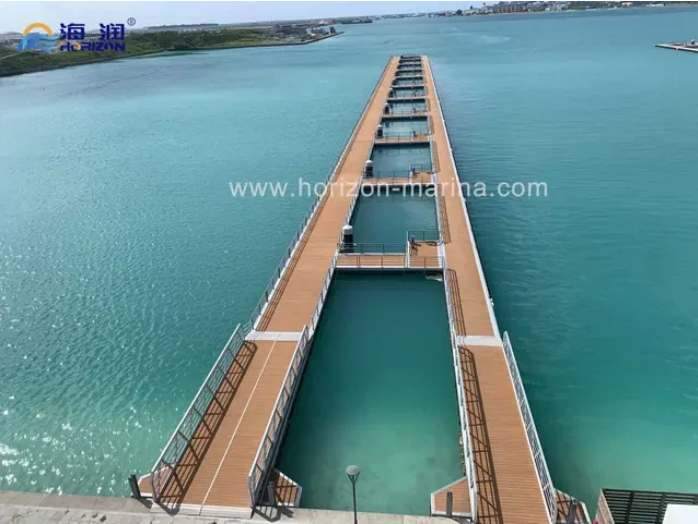
In many projects, a single pontoon is only one part of a larger arrangement. Multiple pontoons can be linked together to form main walkways, finger piers, access platforms, and service areas. This is another important part of how concrete pontoons work in practice. They can function as individual units, but they are also highly effective as coordinated sections in a broader marina layout.
This kind of modular use gives planners more flexibility. A project can be designed around site conditions, traffic patterns, berth needs, and operational goals while still maintaining a unified floating system. When connected properly, multiple sections help the marina work as one organized platform rather than a collection of separate pieces.
A dock becomes far more useful when it supports the services needed in real marina operation. Power supply, water access, lighting, cleats, and fendering all add practical value to the platform. These are not extra details with little importance. In many projects, they are part of what makes the dock truly functional.
Because concrete pontoons provide a stable base, they are well suited to support these operational needs. A platform that remains steady is easier to equip and easier to use. That helps the marina run more smoothly from both the operator’s side and the visitor’s side.
Operational support is also about flow. People need to walk the dock with confidence, step on and off vessels more comfortably, and move through the marina without unnecessary difficulty. A stable floating pontoon improves that experience by giving the dock a calmer and more dependable working character.
This is often one of the most noticeable benefits in daily use. Even when users do not think about engineering, they feel the result in the way the platform behaves.
Concrete pontoons are also useful because they can serve more than one type of area within a project. They may be used in marina walkways, berthing sections, service zones, and floating dock applications where stable support matters. This flexibility makes them suitable for both compact projects and larger waterfront developments.
A pontoon has to keep working in moisture, sunlight, salt, impact conditions, and frequent use. Long-term reliability depends heavily on durability, and this is one reason concrete remains attractive in marine infrastructure. A durable structure helps reduce repair pressure and supports a longer service life.
That matters for daily operations as well as long-term project value. When the dock needs less frequent intervention, the waterfront can remain more usable and more consistent in appearance and performance.
Material strength alone does not guarantee reliable operation. The system also needs to be designed with practical service life in mind. A well-planned pontoon layout makes it easier to keep the dock operating smoothly over time. Good design reduces unnecessary maintenance difficulty and helps the platform stay useful in real conditions.
This is why working performance is not only about flotation. It is about how the whole system continues to serve the marina after installation.
The way a pontoon works directly affects how the waterfront functions every day. If the platform can adapt to water-level changes, stay aligned, support traffic, and carry practical marina loads, the project becomes easier to operate and more comfortable to use. For marina developers and dock planners, that is the real meaning of performance. It is not only about floating on the surface. It is about remaining useful, reliable, and steady in daily service.
Concrete pontoons work through a combination of coordinated flotation, controlled movement, practical load support, and durable marine design. The floating body supports the platform, the guide or anchoring system keeps it in position, and the deck and fittings turn it into usable marina infrastructure. That is why this type of dock system performs so well in marinas and floating docks that require dependable everyday operation. Horizon Marina develops solutions for projects that need exactly that balance of function and stability. If you are planning a marina or waterfront access project, contact us to learn more about a reliable Floating Pontoon solution for your application.
They rise and fall with the water, which helps the dock remain practical under tidal movement and normal level variation.
Anchoring and guide systems control its position while still allowing the vertical movement needed for floating performance.
Yes. They can support practical service features such as cleats, fenders, lighting, and utility access needed in daily marina operation.
Because multiple sections can be linked into one coordinated floating system, making it easier to build organized walkways, berths, and service areas.