

Views: 0 Author: Site Editor Publish Time: 2026-07-09 Origin: Site


A floating pontoon serves as the buoyant foundation for modern marine infrastructure, replacing rigid pilings driven into the seabed. These structures consist of air-tight, buoyant chambers supporting a platform above the water. Traditional fixed docks struggle against tidal fluctuations, severe weather, and deep-water challenges. A floating system solves these limitations by rising and falling naturally with the water level. This adaptability protects marine investments from structural stress and flooding.
Waterfront property owners and marina operators face constant environmental challenges. Modularity, advanced material engineering, and structural adaptability make floating systems essential. You will learn how these systems work, the materials used to build them, and how to select the right configuration for your specific waterfront conditions. We will cover the engineering principles, material differences, and installation requirements that dictate long-term performance on the water.
A floating pontoon is a buoyant marine structure designed to create a stable platform on the water without relying on a fixed deck elevation. Instead of remaining at one height like a traditional fixed pier, the pontoon rises and falls with changes in tide or water level while remaining connected to an anchoring or mooring system.
Floating pontoons can be built from marine-grade aluminum, reinforced concrete, or engineered polyethylene, depending on the required load, environmental conditions, vessel types, and project application. Individual pontoons may function as standalone platforms or connect with other units to form a complete floating pontoon system for marinas, yacht berths, waterfront developments, passenger access, fuel docks, and other marine facilities.
In a modern dock system, the pontoon provides both buoyancy and usable deck space. Its flotation structure supports the dead load of the frame, decking, utilities, and accessories as well as live loads from people, equipment, and marina operations. Anchoring systems control horizontal movement while still allowing the structure to move vertically with the water.
This combination of buoyancy, controlled movement, and modular configuration is what makes floating pontoons particularly suitable for locations with tidal variation, changing reservoir levels, deep water, or waterfront projects where a fixed pier would be less practical. The final design must therefore consider not only flotation, but also freeboard, load distribution, stability, connections, anchoring, access, and expected marine conditions.
Every reliable unit consists of three primary components working together to ensure buoyancy and structural integrity over decades of use.
The structural shell: This outer casing protects the interior from impacts, marine growth, and UV degradation. Materials vary based on environmental demands, ranging from high-density polyethylene to marine-grade aluminum alloys. The shell must resist constant abrasion from floating debris and boat hulls.
The buoyant core: Manufacturers fill interiors using EPS (Expanded Polystyrene) foam or design sealed air chambers. Foam-filled cores prevent sinking if the outer shell suffers a puncture. The closed-cell structure of the foam ensures that even if the casing is breached by a sharp impact, water cannot displace the trapped air.
Connection brackets: Heavy-duty hinges, rubber block connectors, and structural frame interfaces link individual units. These connections must withstand constant dynamic wave stress, torsion, and shear forces. Poorly designed connectors are the leading cause of structural failure in rough water conditions.
These systems rely on fundamental fluid dynamics to support massive weights without compromising the freeboard height.
Archimedes' principle: An object displaces a volume of water equal to its own weight. High-capacity buoyancy occurs because the pontoon displaces a massive volume of water relative to its lightweight shell. Engineers calculate the exact displacement required to keep the deck at a specific height above the waterline, even fully loaded.
Hydrostatic pressure resistance: Deep draft loads exert crushing force on submerged structures. Engineers design internal baffles and structural ribs to prevent collapse under extreme pressure. This is particularly critical for heavy-duty concrete units that sit lower in the water column.
Center of gravity management: Keeping the center of gravity low prevents the structure from tipping. Ballast is sometimes added to the lower sections of the pontoon to increase stability in high-wind areas.
Designers choose between two distinct structural approaches based on the site requirements and future expansion plans.
Monolithic: These continuous, single-structure foundations offer high stability. They work best for permanent, heavy-duty commercial installations where wave attenuation is a primary goal. Monolithic structures are poured or welded as massive single units, making them incredibly rigid but difficult to transport and install.
Modular: Interlocking individual pods allow customized configurations. You can easily expand or reconfigure a modular system as your needs change. If a single module sustains damage, you can unbolt and replace it without dismantling the entire dock system.
Selecting the right material determines the lifespan and performance of your dock. Each material offers distinct advantages for specific marine environments. The choice impacts everything from installation logistics to long-term maintenance schedules.
An Aluminum Pontoon system provides an exceptional strength-to-weight ratio. Marine-grade alloys, specifically 6061-T6, resist corrosion aggressively in harsh saltwater environments. The metal flexes slightly under dynamic wave stress, preventing structural fractures that plague more rigid materials. This material remains a top choice for both residential and commercial applications requiring longevity and low maintenance. Aluminum frames also allow for easy integration of utility channels for water and shore power.
Large commercial marinas often rely on concrete systems. These massive structures provide excellent wave attenuation, calming the water inside a marina basin. They offer extreme durability against severe weather and heavy vessel impacts. The mass of the concrete dampens wave action, creating a highly stable walking surface. However, concrete requires high installation complexity, heavy cranes, and specialized transport barges due to its massive weight.
Plastic units feature high impact resistance and UV stabilization. Manufacturers mold these without seams, reducing the risk of leaks. They fit perfectly into light residential use and highly modular designs. Polyethylene resists marine borers, chemical degradation, and freezing temperatures effectively. These are often the easiest to install for DIY waterfront property owners.
Material Type | Expected Lifespan | Maintenance Level | Load Capacity | Best Application |
|---|---|---|---|---|
Marine-Grade Aluminum | 30+ Years | Low | Medium to High | Saltwater marinas, residential docks |
Heavy-Duty Concrete | 40+ Years | Low | Very High | Commercial wave attenuators |
Rotomolded Polyethylene | 15-25 Years | Very Low | Light to Medium | Lakes, modular residential platforms |
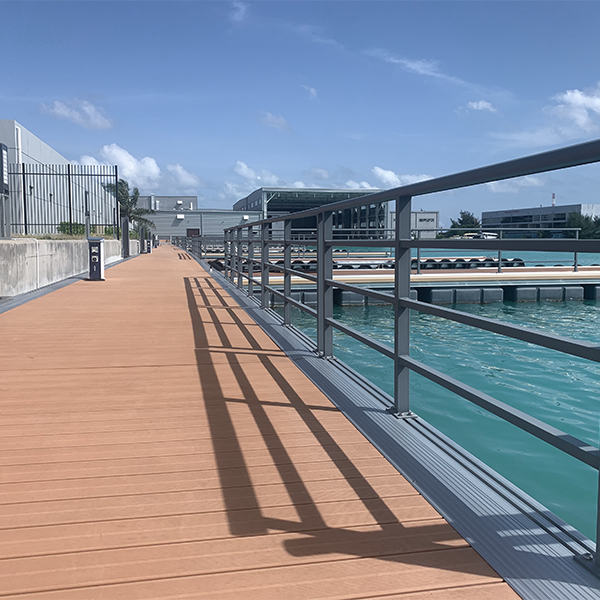
Modern waterfronts require dynamic solutions. Fixed structures fail when environmental conditions shift. Buoyant systems provide the necessary adaptability to handle changing water levels, heavy loads, and severe weather events without sustaining structural damage.
Many waterbodies experience dramatic depth changes. Floating systems naturally rise and fall alongside tidal shifts, seasonal floods, and reservoir drawdowns. This constant elevation matching eliminates dangerous vertical step-down hazards during low tides. Users always step onto their boats from a level platform. In areas with extreme tidal ranges, floating systems are the only viable option for safe vessel boarding.
Stability determines user safety on the water. A well-engineered Floating Pontoon distributes structural dead loads and live loads evenly. Dead loads include decking, framing, and utility pedestals. Live loads involve pedestrians, cargo, and equipment. Multiple buoyant chambers work together to mitigate roll, pitch, and yaw. This creates a solid walking surface that feels nearly as stable as land, even when multiple people stand on one edge of the dock.
A floating structure must remain securely in place despite wind, currents, and boat wakes. The anchoring method depends entirely on the water depth and seabed composition.
Spud poles and piling guides: Vertical pipes driven into the seabed allow the dock to slide up and down securely. Rollers inside the piling guides prevent binding and reduce noise.
Chain and anchor arrays: Deep-water installations utilize crisscrossing heavy chains attached to concrete block anchors or helical screw anchors. This method requires precise tensioning to prevent excessive lateral movement.
Stiff-arm mooring systems: Rigid arms connect the dock directly to a reinforced shoreline bulkhead. This is ideal for deep water near the shore where driving pilings is impossible.
Seaflex or elastic rodes: Modern synthetic mooring lines stretch and retract with the tide, keeping the dock centered without the heavy footprint of bottom chains.
A floating access pontoon is a floating platform designed primarily to provide safe and convenient access between the shore, a gangway, boats, berths, or other parts of a marina. Because the pontoon moves vertically with the water level, it can help maintain a more consistent boarding point in locations affected by tides or seasonal water-level changes.
In a typical marina layout, a floating access pontoon may connect to the shore through a hinged gangway. From the access pontoon, users can then reach the main walkway, finger pontoons, yacht berths, service areas, or passenger boarding points. The pontoon therefore acts as part of the transition between land-based infrastructure and the floating dock system rather than simply serving as an isolated platform.
The design of floating access pontoons depends on the intended use. Important considerations include:
Freeboard: The deck height should suit the vessels, passengers, and boarding requirements of the project.
Load capacity: The structure must accommodate expected pedestrian traffic, equipment, utilities, and other operational loads.
Width and stability: Commercial or high-traffic access routes generally require sufficient walking space and stable flotation.
Gangway connection: Hinges and transition plates should accommodate changes in angle as the pontoon moves with the water.
Anchoring and movement control: Piles, guides, chains, or other mooring systems may be used to limit lateral movement while allowing vertical travel.
Safety features: Depending on the application, handrails, non-slip decking, lighting, fenders, cleats, and utility services may be incorporated.
Floating access pontoons are commonly used in commercial marinas, yacht clubs, resorts, waterfront developments, passenger boarding facilities, and private dock systems. For large marina projects, the access pontoon should be engineered as part of the complete floating pontoon system so that its freeboard, connections, anchoring, gangway geometry, and load requirements work together.
Integrating boats with floating structures requires specific design considerations. Vessel types dictate how the dock must perform during mooring maneuvers. The dock must accommodate the draft, beam, and propulsion style of the boats using it.
Users often face motor clearance and propulsion challenges when docking high-riding tritoon boats. The motor sometimes sits too high to propel the vessel smoothly into a standard floating slip. Solutions include designing low-clearance entry points and widening the slip. Adding heavy-duty guide rollers helps operators manage wind drift during slow-speed docking maneuvers. Fenders must be positioned higher on the dock frame to align with the aluminum logs of the boat rather than a traditional fiberglass hull.
Lifting a vessel out of the water prevents hull blistering, marine growth, and electrolysis. Free-floating lifts integrate seamlessly with various dock configurations. They operate pneumatically, pumping air into submerged tanks to raise the boat. These systems feature adjustability to adapt to different log configurations, tritoon hulls, and traditional V-hulls. Because the lift floats with the dock, the relationship between the boat and the boarding platform remains constant regardless of the tide.
Modern installations prioritize user experience and vessel protection through integrated hardware.
Integrated bumper strips absorb impact energy during rough landings, protecting both the dock frame and the boat hull.
Strategically placed cleats handle heavy mooring lines without tearing out of the frame. Cleats should be bolted directly through the structural aluminum or steel frame, never just into the decking.
Transition ramps and gangways feature engineered hinges and transition plates for safe articulation at any tide level, preventing trip hazards.
Solar-powered deck lighting ensures safe navigation during night operations without requiring complex underwater wiring.
The scale and purpose of the waterfront dictate the system design. Engineers approach private and public installations differently, factoring in traffic volume, vessel size, and regulatory requirements.
Homeowners demand aesthetics and versatility. Residential systems create swimming platforms, kayak launches, and private boat slips. Designers focus on aesthetic integration. They often top the buoyant substructure using modern composite decking, modified pine, or exotic hardwoods like Ipe. This creates a seamless transition from the backyard to the water. Residential docks usually require lower freeboard heights to make boarding small watercraft like paddleboards easier.
Public facilities face intense daily wear and tear. Commercial designs prioritize heavy-duty utility docks, fuel docks, and public ferry boarding platforms. Engineers design these structures for high-frequency foot traffic and massive vessel displacement. They must ensure strict ADA compliance for accessibility, requiring specific gangway slopes and continuous handrails. Furthermore, commercial docks include internal routing for high-capacity water lines, heavy-duty shore power cables, and fire suppression equipment.
Investing in marine infrastructure requires careful site analysis. You must evaluate several critical factors before finalizing a design or purchasing materials. Guesswork leads to structural failure and sunken investments.
Environmental forces dictate structural requirements. Assess wind load exposure across the open water fetch. Measure average current speed and wave height frequencies. Consider ice management carefully. Determine if the units can remain in the water during freezing conditions or if they require seasonal removal. In areas with heavy ice flows, modular plastic systems may be crushed, whereas heavy concrete or specialized aluminum frames can withstand the pressure.
Accurate math prevents sinking and instability. You must factor in the total dead weight of the decking, framing, and permanent accessories. Add the maximum anticipated live weight of passengers, cargo, and moving equipment. Choose a system that offers a buoyancy rating well above your calculated maximum load. A standard rule of thumb is to design for 30 to 50 pounds per square foot of live load capacity depending on the application.
New installations rarely exist in a vacuum. Ensure precise alignment with existing slips and boat lifts. Verify that your chosen anchoring method integrates safely with existing shoreline structures or bulkheads. If you are expanding an older dock, the new pontoons must match the freeboard height of the existing structure to prevent dangerous step-ups or step-downs.
Upgrading your waterfront requires careful planning, accurate site assessment, and quality materials. Take the following actions to ensure a successful project:
Conduct a thorough site survey to measure water depth fluctuations, seabed composition, and wave exposure.
Calculate your total load requirements, factoring in both permanent structures and peak visitor traffic.
Consult a marine structural engineer to match the pontoon material to your local environmental stresses.
Review local zoning laws and secure necessary environmental permits before purchasing materials.
A: Lifespan depends heavily on the material and environment. Marine-grade aluminum and concrete systems often last 30 to 40 years with minimal maintenance. Polyethylene plastic units typically provide 15 to 25 years of reliable service. Regular inspections of the connection hardware and anchoring systems extend the life of any marine structure.
A: This depends on your specific system and local ice conditions. Some heavy-duty designs withstand freezing and static ice pressure. However, shifting ice flows can crush lighter modular plastic systems. Always consult the manufacturer regarding winterization protocols for your specific region.
A: Deep-water installations typically utilize a chain and anchor array. Heavy chains cross beneath the water surface, connecting the dock frame to massive concrete block anchors or helical screws on the seabed. This setup allows the dock to rise and fall while restricting lateral movement.
A: No. High-quality systems use closed-cell EPS foam inside the outer shell. If a boat impact or debris punctures the casing, the foam block does not absorb water. The unit retains its buoyancy, keeping the dock safely afloat until repairs occur.
A: Yes, but you must use a compatible free-floating boat lift. Traditional bottom-standing lifts do not work well with floating docks in fluctuating water. Pneumatic floating lifts attach to the dock frame and rise or fall in unison with the entire system.