

Views: 0 Author: Site Editor Publish Time: 2026-10-06 Origin: Site


Upgrading or constructing a marina demands careful planning and foresight. You must balance upfront infrastructure capital against long-term boater satisfaction. A well-designed electrical layout ensures safe, reliable operations across your facility. Under-equipping docks often leads to dangerous utility sharing among boaters. Tripped breakers frustrate your guests and result in lost transient revenue. Conversely, over-equipping your docks inflates capital expenditure needlessly. It also creates unnecessary maintenance overhead for your crew. You need a clear, engineering-aligned framework to navigate these choices. We will help you calculate the proper pedestal density for your specific berth layout. You will learn how to specify utility loads accurately for modern vessels. Finally, we will evaluate durable materials and smart metering technologies. These actionable insights help maximize your return on investment while ensuring absolute safety.
The industry standard baseline is one service pedestal per two adjacent slips, but vessel size and layout geometry often necessitate a 1:1 ratio for larger berths.
Power planning must account for peak seasonal loads and future-proof against the rising electrical demands of modern vessels (including dual 50A or 100A+ requirements).
Selecting marine-grade materials (like 316L stainless steel or heavy-duty composites) directly impacts the lifespan of a dock power pedestal in corrosive environments.
Integrating smart metering into utility pedestals shifts power consumption from an overhead cost to a recoverable, automated revenue stream.
Many facilities share a single Service Pedestal between two slips. This standard approach reduces trenching requirements significantly. You use less cabling and purchase fewer hardware units. Labor costs drop because electricians wire fewer connection points. This ratio works best for smaller slips under 30 feet. Smaller boats have lower power demands. The physical distances between the boats remain highly manageable. Two standard 30-amp receptacles fit easily into one unit. Sharing utilities here rarely causes logistical conflicts.
Larger vessels over 50 feet dictate a different strategy. They require dedicated units due to high continuous amperage draws. A megayacht might pull 100 amps constantly to run air conditioning and stabilizers. Cable management logistics also force a 1:1 ratio. Thick, heavy 100-amp power cords are difficult to maneuver. Boaters cannot drag them across wide walkways. Floating dock layouts often limit where you can place heavy utility hubs. A dedicated unit positioned near the vessel's transom eliminates these physical hurdles.
Electrical safety codes regulate shore power cord lengths. You must ensure no vessel requires a shore cord exceeding 50 feet. Longer cords create dangerous tripping hazards on the deck. They also introduce severe voltage drop issues. If a boater strings together multiple cords, the connection points risk overheating. You should map your layout to guarantee every slip falls within this 50-foot radius. Proper placement keeps your facility compliant and your guests safe.
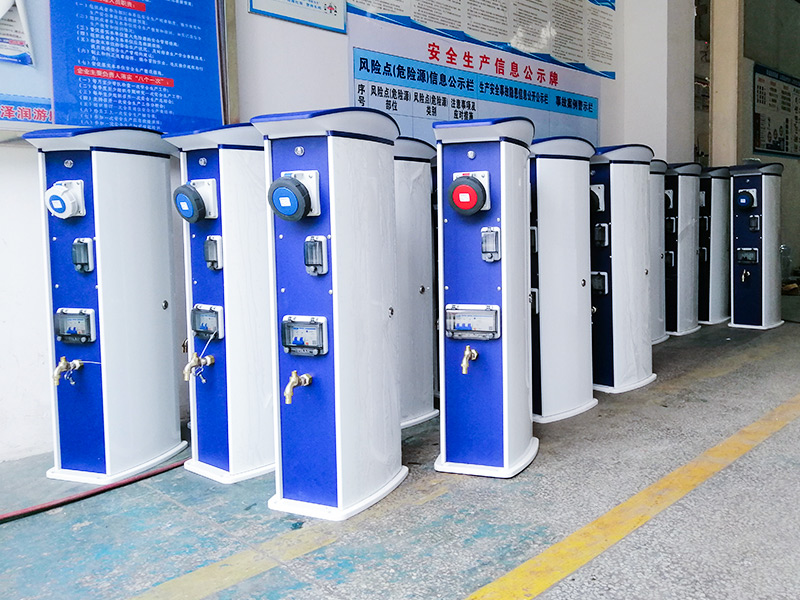
Modern vessels consume more electricity than ever before. You must plan your amperage configurations accordingly. Small to medium craft usually require standard 30A and 50A configurations. They operate on 125V or 250V systems. Large transient berths demand much more capacity. Megayachts often require 100A, 200A, or even 480V 3-phase power. Supplying 3-phase power requires specialized transformers and heavy-duty cabling. You must consult your local utility provider to ensure adequate grid capacity.
Typical Vessel Power Requirements by Length
Vessel Length | Typical Power Configuration | Recommended Receptacles |
|---|---|---|
Up to 30 feet | Single 30A (125V) | 1x 30A Twist-Lock |
30 to 50 feet | Dual 30A or Single 50A | 2x 30A or 1x 50A (125/250V) |
50 to 80 feet | Dual 50A or Single 100A | 2x 50A or 1x 100A Pin & Sleeve |
80+ feet | 100A+ or 3-Phase 480V | 100A+ Pin & Sleeve / Hardwire |
A modern dock power pedestal acts as a comprehensive utility hub. Electricity is only the beginning. You should integrate several other services to improve the boater experience.
Water hookups: Decide between dual hose bibs or single bibs. Dual bibs prevent sharing conflicts on a 1:2 layout.
Data and Communications: Include hardwired internet ports. Many units house Wi-Fi repeaters to boost signal strength across the marina. Cable TV connections remain popular for liveaboards.
Environmental lighting: Integrate photocell-controlled LED lighting. Soft downward illumination improves dock safety without blinding navigators at night.
Voltage drop threatens equipment longevity and safety. Electricity loses pressure as it travels over long distances. You must calculate wire gauge and run lengths carefully from the main transformer. If the cables are too thin, the furthest berth power pedestal will receive low voltage. Low voltage forces boat motors and air conditioners to draw more current. This excessive current overheats wires and trips breakers. Engineers generally recommend keeping voltage drop below 3% for sensitive marine electronics. Proper cable sizing prevents these dangerous scenarios entirely.
Many facilities choose polycarbonate for their utility hubs. These engineered plastics offer tremendous benefits. They boast high corrosion resistance. They are UV stable, preventing yellowing in harsh sunlight. Crucially, they are completely non-conductive. This feature enhances safety around wet environments. Polycarbonate models are highly cost-effective upfront. However, they carry some drawbacks. They can become brittle under severe long-term weather exposure. Extreme physical impacts from heavy dock carts or boat bows may shatter them.
Luxury facilities often prefer marine-grade metals. Type 316L stainless steel provides maximum structural integrity. Aluminum offers similar strength at a lighter weight. Both materials withstand heavy commercial use beautifully. They deliver a premium, polished aesthetic. However, they demand a much higher upfront capital investment. Metals also require strict grounding and isolation protocols. Without proper isolation, galvanic corrosion will destroy a metal casing rapidly. You must inspect metal units frequently for bonding failures.
You must weigh upfront material costs against the inevitable replacement cycle. A marina service bollard faces vastly different conditions depending on location. Saltwater environments act as highly corrosive accelerators. Cheap metals will blister and fail within a few short years. Freshwater environments are much gentler on infrastructure. Spending more on 316L stainless steel in a saltwater marina extends the replacement cycle significantly. You save money long-term by avoiding premature equipment failures. Evaluate your local climate rigorously before finalizing material choices.
Flat-rate electrical billing destroys facility profit margins. Historically, operators rolled power costs into the monthly slip fee. This model worked when boats only ran small lights. Today, modern vessels feature high-draw HVAC and heavy heating systems. Boaters often leave air conditioning running while away for weeks. Unmetered usage forces you to absorb these massive utility bills. Your operational expenses skyrocket during peak summer and winter months. Flat-rate billing no longer supports a sustainable business model.
Smart technology revolutionizes utility management. Automated meter reading (AMR) systems connect via Wi-Fi or mesh networks. You can monitor every marina utility pedestal from your office computer. The software tracks exact kilowatt-hour consumption. You simply invoice the boater for what they actually use. Some systems utilize pre-paid RFID cards. Transient boaters tap their card to activate the power. The system cuts power when the balance depletes. This automation shifts electricity from a heavy burden to a recoverable revenue stream.
Smart pedestals offer critical safety advantages. Electric Shock Drowning (ESD) poses a massive threat in marinas. Faulty boat wiring can leak lethal electrical currents into the surrounding water. Smart units detect these ground faults instantly. They trip the Equipment Protection Device (EPD) immediately. Furthermore, smart software alerts the dockmaster via text message or email when a trip occurs. You can identify the problematic vessel quickly. This remote monitoring prevents tragic accidents and reduces your overall liability.
Marine electrical fires and shocks carry catastrophic consequences. You must adhere strictly to established safety codes. In the United States, the National Electrical Code (NEC) Article 555 governs marinas and boatyards. The NFPA 303 standard provides further fire protection guidelines. Local jurisdictions may impose even stricter amendments. You cannot cut corners during the design phase. A certified marine electrical engineer must review your plans. Non-compliance results in failed inspections, delayed openings, and massive legal liability.
Modern codes require highly sensitive ground fault protection. You must install 30mA Equipment Protection Devices (EPDs) at the pedestal level. Some older facilities placed ground fault protection at the main breaker. This causes nuisance tripping. A single boat leaking current would black out the entire dock. Placing the 30mA EPD right at the slip isolates the fault. Only the offending vessel loses power. The rest of the dock remains fully operational. This approach balances strict safety with boater convenience.
Physical installation requires careful coordination. Consider these key logistical factors:
Mounting footprint considerations: Narrow walkways demand slim unit profiles. Preserve essential deck space for pedestrian traffic and dock carts.
Access for maintenance: Ensure easy-access panels face the walkway. Electricians need clear space to replace breakers and test receptacles safely.
Tidal and storm surge planning: Determine maximum historical flood lines. Mount the units high enough to clear king tides and moderate storm surges. Strict waterproofing standards protect internal components.
Designing the right electrical strategy protects your facility and your guests. You must map your current boater demographics against future electrical trends. Large vessels increasingly demand a dedicated 1:1 layout, while smaller slips operate efficiently on a 1:2 ratio. Selecting durable, marine-grade materials extends equipment lifespan significantly. We encourage you to audit your existing dock power capabilities immediately. Consult with a qualified marine electrical engineer to map out a scalable layout. Upgrading your infrastructure ensures safety, code compliance, and long-term profitability.
A: A standard unit typically provides either dual 30-amp or a combination of 30-amp and 50-amp receptacles. This covers most vessels under 50 feet. Larger transient slips require 100-amp service. Always verify local grid capacity before finalizing your amperage design.
A: Lifespan depends heavily on materials and environment. Polycarbonate units last 10 to 15 years before UV degradation occurs. High-quality 316L stainless steel models can last over 20 years, provided you maintain strict galvanic isolation in saltwater environments.
A: Yes, many modern smart meters are designed for retrofitting. Electricians can install modular smart readers inside existing electrical housings. You will need a reliable Wi-Fi or mesh network across the docks to transmit the consumption data back to your office.
A: Placement guidelines dictate that a unit should sit close enough to the slip so no vessel requires a shore cord longer than 50 feet. Typically, they are mounted within 2 to 3 feet of the slip edge to prevent tripping hazards.