

Views: 0 Author: Site Editor Publish Time: 2026-07-15 Origin: Site


Structural dock failures carry severe safety liabilities and operational disruptions. When a waterfront facility collapses under storm surges or heavy ice loads, the resulting damage extends far beyond the dock itself, threatening vessels, infrastructure, and human life. The foundation of any secure waterfront project lies in its flotation system. Proper selection of marina pontoons dictates the lifespan, stability, and overall viability of the entire structure.
Matching pontoon materials and configurations to specific environmental stressors presents a complex engineering challenge. Project managers must account for wave action, fetch, tidal fluctuations, ice pressure, and precise load-bearing requirements. A miscalculation in buoyancy or material resilience leads to rapid degradation or catastrophic failure during extreme weather events.
This technical evaluation framework provides the criteria needed to assess material trade-offs, structural capabilities, and engineering constraints. By analyzing environmental baselines and load demands, developers can confidently select the right flotation systems for residential builds or commercial waterfront facilities.
Environmental baseline data (fetch, wave height, water depth, and wind loads) must dictate pontoon material selection before budget considerations.
Concrete pontoons offer superior wave attenuation and longevity for commercial applications, while an aluminum pontoon provides a high strength-to-weight ratio ideal for residential and modular projects.
Regulatory compliance and environmental permitting often restrict certain flotation materials (e.g., exposed foam) depending on local jurisdictions.
Site conditions dictate the structural requirements of any marine installation. Fetch, defined as the unobstructed distance wind travels over water, directly influences wave generation. Large fetch distances produce high-energy waves that require massive pontoon displacement and robust attenuation capabilities. Engineers calculate the maximum anticipated wave height and frequency to determine the necessary mass and structural rigidity of the dock system.
Tidal ranges and seasonal water level fluctuations introduce vertical stress on mooring systems. Docks must articulate smoothly without binding or stressing connection hinges. Ice pressure presents another severe environmental stressor. In freezing climates, expanding ice can crush lightweight pontoons or lift piles out of the lakebed. Flotation systems must either withstand lateral ice compression or be designed for seasonal removal.
Choosing between a floating pontoon dock and a stationary system depends heavily on water depth and bed composition. Deep water, soft lakebeds, and significant water level fluctuations necessitate floating systems. Stationary docks perform better in shallow water with high-exposure rough conditions, as they avoid the dynamic stress of wave action entirely.
Site Condition | Floating Dock Suitability | Fixed Dock Suitability |
|---|---|---|
Water Depth > 4 feet | Excellent | Poor (Requires massive piles) |
High Tidal Fluctuation | Excellent (Adjusts automatically) | Poor (Deck submerges or strands boats) |
Heavy Wave Action (High Fetch) | Requires heavy concrete attenuation | Excellent (If built above wave crest) |
Soft Mud/Silt Lakebed | Excellent (Anchored or Seaflex) | Poor (Piles sink or lose friction) |
Accurate load calculations prevent dock listing and structural fatigue. Dead load encompasses the weight of the dock structure, decking, utility lines, and permanent fixtures. Live load accounts for pedestrian traffic, gangway reactions, snow accumulation, and temporary equipment. Commercial facilities require high buoyancy reserves to support heavy, continuous foot traffic and large utility transformers.
Residential applications typically experience intermittent, lighter loads. However, they still require precise buoyancy distribution to prevent uneven settling. Commercial marinas also demand higher structural stiffness to handle the kinetic energy transferred from large yachts during docking maneuvers.
Slip sizing and space configurations require careful planning, especially when accommodating wide-profile vessels. Docking catamarans or pontoon boats alongside residential floating docks requires expanded slip widths. Engineers factor in maneuvering clearances, windage, and the turning radius of specific vessel types to prevent collisions and ensure safe harbor.
Calculate the total dead load by summing the weights of the frame, decking, floats, and permanent hardware.
Determine the required live load capacity based on local building codes (typically 30 to 50 psf for residential, up to 100 psf for commercial).
Add a safety factor of at least 20% to account for unexpected point loads or heavy snow accumulation.
Distribute the required buoyancy evenly across the pontoon layout to ensure a level deck under resting conditions.
Environmental regulations heavily influence material selection. Many jurisdictions have implemented strict bans on unencapsulated Expanded Polystyrene (EPS) foam due to its tendency to degrade and pollute waterways. Modern environmental standards require flotation billets to be fully encased in impact-resistant shells to prevent microplastic contamination and wildlife hazards.
Securing permits requires comprehensive documentation. Local waterway authorities and environmental agencies demand stamped marine engineering plans detailing load calculations, mooring designs, and material specifications. Initiating procurement before securing these approvals often leads to costly redesigns or project cancellations if the chosen materials violate local ordinances.
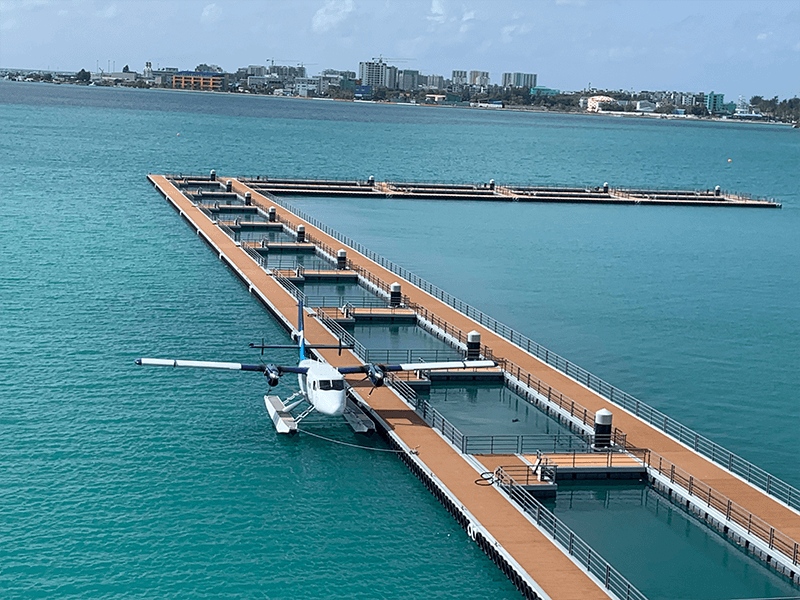
Heavy-duty concrete systems dominate the commercial marina sector. The massive weight and high displacement of a Concrete pontoon provide exceptional stability and wave attenuation. These structures act as floating breakwaters, absorbing and reflecting wave energy to create calm interior basins. The low center of gravity minimizes rolling, providing a solid, land-like feel underfoot.
Concrete structures resist marine borers, rot, and UV degradation. The sheer mass requires heavy machinery, cranes, and specialized barges for installation. Once deployed, concrete systems offer limited flexibility for reconfiguration. The rigid nature of the infrastructure means slip layouts are largely permanent, requiring careful upfront planning.
For projects requiring high structural integrity without excessive weight, an Aluminum Pontoon provides an optimal solution. The exceptional strength-to-weight ratio makes aluminum ideal for residential docks, rowing clubs, and modular commercial applications. Aluminum naturally forms a protective oxide layer, offering excellent corrosion resistance in freshwater environments.
In saltwater applications, marine-grade aluminum alloys perform well when properly isolated from dissimilar metals. The lightweight nature of aluminum simplifies transport and allows for rapid deployment. Modular designs enable easy expansion or reconfiguration of slip layouts as facility needs evolve.
Thick-walled HDPE pontoons deliver extreme durability against impact, UV radiation, and marine borers. These heavy-walled systems resist punctures from floating debris and ice damage. HDPE does not rust, rot, or require protective coatings, making it highly reliable for long-term deployment.
The marine industry has largely shifted away from legacy materials toward rugged HDPE for encapsulated flotation. The zero-rust characteristics and high impact resistance make HDPE suitable for both commercial docking applications and rugged residential builds. The material flexes under stress, absorbing kinetic energy that might fracture more rigid materials.
Historically, steel pontoons provided the necessary strength for large-scale marine infrastructure. Their use has declined significantly in favor of concrete and HDPE alternatives. Steel requires relentless maintenance to combat the harsh marine environment. Without rigorous upkeep, rapid degradation compromises structural integrity.
Maintaining steel systems involves regular application of epoxy coatings and the management of cathodic protection systems to prevent rust. While still used in specific heavy industrial applications, the ongoing maintenance burden makes steel less practical for standard marina projects compared to modern composite and concrete alternatives.
Calculating required buoyancy involves summing the dead and live loads and factoring in a safety margin. The pontoon must displace enough water to support these loads without submerging past its designed waterline. Insufficient buoyancy leads to submerged decks, accelerated hardware corrosion, and unsafe walking surfaces.
Freeboard, the distance from the water surface to the dock deck, must match the intended vessel types. Rowing shells and kayaks require a low freeboard for safe boarding. Commercial yachts and large vessels require a high freeboard to align with boarding gates and prevent the dock from sliding under the vessel's hull during heavy wave action.
Vessel Type | Recommended Freeboard | Primary Pontoon Material Match |
|---|---|---|
Rowing Shells / Kayaks | 6 to 8 inches | Low-profile HDPE or Aluminum |
Residential Pontoon Boats | 12 to 16 inches | Standard Aluminum or HDPE |
Deep-V Center Consoles | 16 to 20 inches | Heavy Aluminum or Concrete |
Commercial Yachts | 20+ inches | Massive Concrete Pontoons |
The pontoon structure must integrate seamlessly with the site's mooring requirements. Mooring systems anchor the dock in place while allowing vertical movement. Options include piling rings, chain and anchor blocks, elastic Seaflex systems, or rigid stiff arms. The choice depends on water depth, bed composition, and environmental exposure.
Dynamic mooring loads during storm events transfer massive kinetic energy to the dock structure. Pontoons must feature heavily reinforced structural connection points to handle these forces. Through-bolted hardware, reinforced gussets, and heavy-duty backing plates prevent cleats and mooring brackets from tearing out of the pontoon frame under extreme tension.
Protecting both the dock and the vessels requires integrated fendering systems. Heavy-duty, impact-absorbing fenders and continuous rub rails prevent structural damage during docking maneuvers. Cleat placement must align with standard vessel tie-off points while avoiding trip hazards on the deck.
Configuring dock space layouts requires analyzing prevailing winds and currents. Slips should be oriented to allow vessels to dock into the wind or current whenever possible. Proper layout accounts for mooring line angles and ensures fenders are positioned to protect fragile hulls from rubbing against the dock infrastructure.
Modern marinas require extensive utility networks, including potable water, high-voltage electrical service, and sanitary pump-out lines. Pontoons must accommodate internal routing of these utilities without compromising structural integrity or watertightness. Utility raceways should be easily accessible for maintenance while remaining fully isolated from the water.
Flexible utility connections between pontoon modules must accommodate hinge articulation without pinching or severing lines. Proper grounding and fault protection are critical when routing electrical services through metallic or wet environments to prevent stray current leakage and ensure human safety.
Deploying metallic structures in saltwater environments introduces the severe risk of galvanic corrosion. When dissimilar metals connect in an electrolyte, the less noble metal degrades rapidly. This is especially problematic when mixing aluminum frames with steel hardware or mooring chains.
Mitigation requires strict dielectric isolation between incompatible metals using nylon washers, Delrin bushings, or specialized isolation pads. Installing sacrificial anodes provides a preferential corrosion target, protecting the primary structural components. Marine-grade coatings add an additional barrier against environmental wear.
Extreme weather events place immense stress on the hinges and connection points between pontoon modules. Fatigue at these junctions represents a primary failure mode for floating docks. Rigid connections shatter under dynamic wave action, while excessively loose connections cause violent jerking that tears hardware apart.
Engineering tolerances must allow for controlled articulation. Heavy-duty articulation hardware, such as rubber-bushed hinges or torsion blocks, absorbs kinetic energy and dampens movement. Regular inspection of connection pins, bushings, and bolts is mandatory to identify and replace fatigued components before catastrophic failure occurs.
Procurement timelines vary drastically based on material selection. Custom-cast concrete pontoons require significant lead times for curing and specialized heavy transport. Off-the-shelf aluminum extrusions or standard HDPE billets often feature shorter supply chains and faster deployment capabilities.
Vetting marine contractors is critical. A contractor experienced in driving timber piles may lack the specialized knowledge required to tension a chain-and-anchor system for a heavy concrete breakwater. Verify that the chosen installation team possesses specific, documented experience with the exact pontoon material and mooring system specified for the project.
Selecting the correct flotation system dictates the operational success of any waterfront facility. There is no universal solution; the optimal choice depends entirely on site-specific environmental data, precise load calculations, and regulatory constraints.
To ensure a successful dock installation, follow these immediate next steps:
Commission a formal bathymetric survey to map water depths, bed composition, and underwater obstructions prior to design.
Consult with a licensed marine structural engineer to finalize dead and live load calculations based on intended usage.
Submit engineered drawings to local waterway authorities to secure necessary environmental permits before initiating procurement.
Schedule an on-site evaluation with a specialized marine contractor to verify heavy machinery access and mooring feasibility.
A: Heavy-duty concrete pontoons typically offer a lifespan of 30 to 50 years in commercial applications, provided the mooring hardware is maintained. Aluminum and thick-walled HDPE systems generally last 20 to 30 years. Lifespans are heavily contingent on regular maintenance, proper anode replacement, and the severity of the local marine environment.
A: The decision relies on wave action, required freeboard, and installation access. Concrete is necessary for high-exposure areas requiring wave attenuation and massive stability. Aluminum is preferred for sheltered areas, residential projects, or sites with restricted heavy machinery access, offering modularity and a high strength-to-weight ratio.
A: Stationary docks are generally better for shallow, rough water because they sit above the wave action and avoid dynamic stress. However, if the site features deep water or significant water level fluctuations, a floating dock is mandatory. In rough, deep water, heavy concrete floating breakwaters are required to absorb wave energy.
A: Slip width must accommodate the vessel's beam plus clearance for fenders and maneuvering. Standard practice requires at least 2 to 3 feet of clearance on each side of the boat's widest point. This allowance accounts for line stretch, wind action, and the placement of impact-absorbing fendering systems.
A: Most environmental agencies have phased out the use of exposed Expanded Polystyrene foam due to its tendency to break down and harm aquatic life. Current regulations typically mandate that all flotation foam be fully encapsulated within a rigid, puncture-resistant shell, such as thick-walled HDPE, or utilize solid-wall air-filled pontoons.
A: Leaving a dock in freezing water depends on the material and ice conditions. Moving ice can crush lightweight pontoons or tear mooring systems. Heavy concrete or specialized ice-resistant HDPE can sometimes remain year-round. Installing bubbler systems helps prevent ice formation around the structure, mitigating compression damage.
A: A standard residential pontoon boat typically aligns well with a freeboard of 12 to 16 inches. This height allows for easy boarding and disembarking. Deep-V hulls or larger commercial vessels generally require a higher freeboard, ranging from 18 to 24 inches, to prevent the dock from sliding under the hull.