

Views: 0 Author: Site Editor Publish Time: 2026-07-11 Origin: Site


The structural integrity, safety, and long-term financial viability of any marine infrastructure project rely fundamentally on the substructure material. Specifying the wrong material for a floating pontoon leads to accelerated degradation, exorbitant maintenance costs, and potential catastrophic failure under dynamic environmental loads. Facility managers, marina developers, and coastal engineers must navigate a complex matrix of environmental variables and structural demands before finalizing their designs. An objective, engineering-focused comparison of concrete, aluminum, and high-density polyethylene (HDPE) is necessary to align material properties with specific site conditions, payload requirements, and lifecycle expectations. By evaluating these distinct materials against rigorous operational criteria, project stakeholders can mitigate risk and ensure enduring performance in challenging aquatic environments.
Concrete delivers unmatched mass, stability, and wave attenuation, making it the standard for heavy commercial applications, though it requires significant draft and high initial capital.
Aluminum offers an optimal strength-to-weight ratio and modularity, ideal for residential or inland commercial projects, provided galvanic corrosion risks are managed.
HDPE floaters provide unmatched impact resistance, flexibility, and zero-maintenance performance in highly corrosive, shallow, or ecologically sensitive environments.
Selecting the optimal substructure requires a comprehensive site analysis. Engineers must evaluate multiple intersecting factors to determine which material will perform reliably over the intended design life. Ignoring any of these primary criteria often results in premature structural fatigue or excessive operational expenditures. You must look at the site through the lens of physics, chemistry, and daily operations.
The physical environment dictates the baseline requirements for any marine structure. Assessing wave energy, tidal fluctuations, wind loads, and current velocities at the installation site is the critical first step. High-energy environments with significant fetch require materials capable of absorbing or deflecting wave action without compromising structural integrity. Conversely, sheltered water bodies with minimal current allow for lighter, more modular systems. Additionally, engineers must account for extreme weather events, ensuring the chosen pontoon can withstand peak storm surges and localized wind shear. You need to measure the maximum wave height and the wave period to understand the kinetic energy the dock will absorb.
Matching dead loads—the weight of the structure itself—and live loads with material capabilities ensures safety and functional compliance. Live loads include pedestrians, vehicles, heavy equipment, and utility runs. Heavy-duty applications, such as ferry terminals or industrial loading zones, demand materials with immense buoyancy and rigidity to prevent excessive deflection under point loads. Lighter applications, like rowing docks or private slips, prioritize modularity and ease of access over sheer load-bearing capacity. When calculating loads, always factor in the dynamic forces of vessels mooring and casting off, as these exert massive lateral stress on the cleats and the underlying frame.
Every material interacts differently with the marine environment. Balancing resistance to UV degradation, biological fouling, marine borers, and chemical corrosion against ongoing maintenance budgets is essential. Saltwater environments accelerate the oxidation of certain metals, while prolonged sun exposure can degrade inferior plastics. The chosen material must withstand the specific biological and chemical stressors present at the site, minimizing the need for frequent interventions, protective coatings, or component replacements. Barnacle growth, for instance, adds significant weight over time, altering the draft and freeboard of the dock.
Financial planning for marine infrastructure extends far beyond the initial purchase price. Analyzing the balance between Capital Expenditure (CAPEX) and Operational Expenditure (OPEX) over a 20-to-50-year design life provides a realistic picture of the investment. A material with a lower upfront cost might demand rigorous, ongoing maintenance, thereby inflating the OPEX. Conversely, a high-CAPEX material often yields substantial savings over decades through reduced upkeep and longer intervals between major overhauls. You must calculate the labor hours required for annual inspections, anode replacements, and pressure washing.
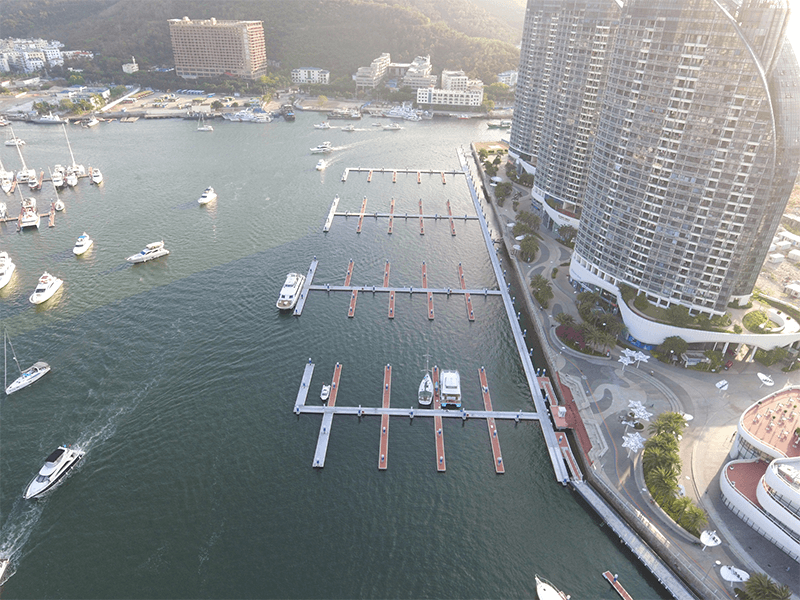
For decades, the Concrete pontoon has served as the backbone of heavy marine infrastructure. Its inherent mass and structural rigidity make it the preferred choice for environments demanding uncompromising stability and longevity. When you walk on a well-engineered concrete dock, it feels like walking on solid ground.
The defining characteristic of a concrete substructure is its high mass and low center of gravity, yielding superior stability even under shifting live loads. These structures typically utilize internal reinforcement configurations, such as prestressed or post-tensioned steel cables, encased within high-strength marine-grade concrete. An Expanded Polystyrene (EPS) core is often integrated to provide unsinkable buoyancy. Furthermore, the sheer bulk of the concrete acts as a natural breakwater, offering excellent wave attenuation capabilities that protect moored vessels and inner harbor infrastructure. The concrete mix design usually includes silica fume or fly ash to reduce permeability and prevent chloride ion ingress, which would otherwise rust the internal steel.
Due to their robust construction, these pontoons are the standard for commercial marinas, ferry terminals, and heavy-duty industrial docks. They excel in locations exposed to moderate-to-high wave action and deep-water installations where their draft requirements can be easily accommodated. Municipalities and port authorities frequently specify concrete for public access facilities due to its solid, unyielding feel underfoot, which instills confidence in pedestrians and easily supports utility pedestals and heavy gangways. They are also the go-to choice for fuel docks, as the concrete provides a stable, non-combustible platform.
Despite its dominance, concrete is not universally applicable. The primary limitation is its high draft requirement due to the massive dead weight, making these structures entirely unsuitable for shallow water, estuaries, or mudflat grounding. If a concrete structure grounds out on an uneven seabed, the resulting point loads can cause catastrophic structural failure. Furthermore, these are inflexible structures prone to stress cracking under extreme torsional forces if the hinge connections and mooring systems are not engineered correctly. Finally, the high initial CAPEX and complex logistics—often requiring heavy cranes, specialized transport, and marine towing for installation—can push project budgets beyond feasibility for smaller developments.
Site preparation and dredging to ensure adequate depth at mean low water.
Driving heavy steel or concrete guide piles using a barge-mounted pile driver.
Towing the massive concrete modules from the casting yard to the installation site.
Using heavy-lift cranes to position the modules over the guide piles.
Securing the heavy-duty elastomeric hinges between the pontoon sections.
When project constraints demand flexibility, rapid deployment, and a clean aesthetic, marine-grade aluminum provides a highly efficient structural solution. It bridges the gap between heavy civil engineering and adaptable waterfront access. Aluminum systems are highly favored by contractors for their ease of handling.
Aluminum structures boast a remarkably high strength-to-weight ratio, typically utilizing marine-grade alloys such as 6061-T6 or 5086. This exceptional structural efficiency allows for highly modular designs, enabling easy onsite modifications, expansions, or reconfigurations as facility needs evolve. Unlike structural steel, which requires continuous protective coatings, marine aluminum possesses an inherent resistance to atmospheric corrosion, forming a protective oxide layer upon exposure to the elements. This keeps the structure visually appealing and structurally sound above the waterline. The extrusion process allows for custom profiles that integrate track systems for cleats and fenders directly into the frame.
The lightweight nature of aluminum makes it ideal for residential finger docks, rowing club docks, and private slipways. It is heavily utilized in inland waterways, lakes, and sheltered commercial marinas where wave action is minimal. The modularity allows facilities to easily remove the docks during winter months in areas prone to heavy ice flows. Additionally, the clean, modern appearance of aluminum framing is highly sought after in premium residential developments and yacht clubs. They are also excellent for ADA-compliant kayak launches where low freeboard is required.
The most critical vulnerability of aluminum in marine environments is galvanic corrosion. When placed in an electrolyte (like saltwater) and connected to dissimilar metals—such as steel piles or copper-treated wood—aluminum will rapidly degrade. Managing this requires the strict use of isolation gaskets and the diligent maintenance of sacrificial anodes (zinc or aluminum). Furthermore, aluminum is susceptible to structural fatigue and weld cracking under continuous, high-frequency wave cycles. Finally, its low mass offers minimal wave dampening; in rough water conditions, an aluminum dock will ride the waves rather than break them, often requiring the installation of auxiliary breakwaters to protect moored vessels.
Inspect all sacrificial anodes bi-annually and replace them when they reach 50% depletion.
Check all isolation gaskets between the aluminum frame and steel guide rollers.
Visually inspect structural welds for hairline fatigue cracks, especially near cleat attachments.
Wash down the frame with fresh water periodically to remove salt crystal buildup.
Advancements in polymer engineering have positioned the HDPE floater as a formidable alternative to traditional materials. High-Density Polyethylene offers a unique combination of resilience and chemical inertness that solves many legacy infrastructure problems. It is rapidly becoming the material of choice for challenging, dynamic environments.
The defining mechanical property of High-Density Polyethylene is its high ductility. This allows the pontoon to flex and absorb kinetic energy from vessel impacts or severe weather events without permanent deformation. HDPE provides complete resistance to rot, rust, marine borers, and chemical spills, including fuel and solvents, making it incredibly durable in harsh conditions. The material can be thermally welded, creating seamless, watertight compartments that will not separate under stress.
The industry has also seen a shift regarding internal buoyancy. Modern sealed HDPE floaters significantly outperform traditional EPS-filled options. By utilizing thick-walled, air-filled, or structurally ribbed designs, manufacturers mitigate the risk of EPS breakdown, waterlogging, and the resulting microplastic environmental contamination. Furthermore, high-quality HDPE is manufactured with advanced UV stabilization additives, preventing the cracking, chalking, and embrittlement typical of lower-grade plastics exposed to relentless sunlight.
HDPE is the premier choice for intertidal zones where the structure must regularly ground out on mud, sand, or gravel during low tides. Its abrasion resistance ensures the hull remains intact despite repeated bottom contact. It is also highly effective in corrosive marine environments, such as saltwater estuaries or industrial discharge ponds, and ecologically sensitive zones where leaching from treated wood or degrading foam is prohibited. Moreover, it serves budget-conscious projects requiring minimal maintenance and DIY-friendly modular assembly, as the lightweight blocks can often be pinned together without heavy machinery. Workboat harbors and aquaculture facilities rely heavily on HDPE for its sheer toughness.
Engineers must account for HDPE's high thermal expansion and contraction coefficients; rigid connections will fail under temperature fluctuations, necessitating flexible fastening systems. Additionally, HDPE has lower structural rigidity compared to concrete and aluminum, limiting its maximum single-span load capacities and requiring more frequent support structures or tighter mooring configurations. Finally, its lightweight profile offers minimal resistance to strong crosswinds and high-velocity currents, meaning the system must be heavily anchored to maintain its position and shape. You cannot span large distances with HDPE without introducing a secondary structural frame.
To facilitate a clear, objective decision-making process, the following matrix compares the three primary materials across critical engineering and operational metrics. Use this data to align your site conditions with the appropriate material.
Feature / Metric | Concrete Pontoon | Aluminum Pontoon | HDPE Floater |
|---|---|---|---|
Expected Lifespan | 30–50+ Years | 20–30 Years | 20–40 Years |
Maintenance Requirements | Low (inspect joints/seals) | Medium (anode replacement) | Minimal (occasional pressure wash) |
Impact Resistance | Low (prone to spalling) | Medium (prone to denting) | Extremely High (self-recovering) |
Wave Attenuation | Excellent | Poor | Poor to Moderate |
Initial Cost (CAPEX) | High | Medium | Low to Medium |
Environmental Impact | High carbon footprint | Medium (recyclable) | Low (inert, highly recyclable) |
Draft Requirement | Deep (Heavy displacement) | Shallow (Lightweight) | Shallow (Highly buoyant) |
Thermal Expansion | Minimal | Moderate | High (Requires slip joints) |
Selecting the right floating pontoon material requires matching the inherent properties of the substructure to the specific operational realities of the site. Below are three common scenarios and the recommended engineering approach for each. Real-world application always dictates the final specification.
In a coastal environment subjected to significant fetch, wind-driven chop, and heavy commercial vessel traffic, stability and wave attenuation are paramount. The structure must protect the vessels moored within the basin while providing a rigid platform for heavy utility lines and high pedestrian volume. The constant pounding of waves requires massive inertia to remain stable.
Recommended Solution: Heavy-duty concrete pontoon.
Rationale: The massive dead weight of concrete acts as a breakwater, dampening incoming wave energy. Its rigidity easily supports heavy live loads and gangway transitions during extreme tidal shifts, ensuring a safe, stable environment for commercial operations.
Inland waterways often present challenges related to seasonal water level changes, requiring a system that can be easily adjusted, extended, or temporarily removed. Wave action is typically limited to vessel wakes, and the primary users are recreational boaters or rowing clubs requiring low freeboard. Ice flows during winter months pose a significant threat to permanent structures.
Recommended Solution: Modular aluminum pontoon.
Rationale: Aluminum provides the necessary strength without the excessive weight, allowing for easy height adjustments and seasonal removal. Its clean aesthetics blend well with residential or park settings, and the modular frame allows for customized decking options to suit specific recreational needs.
Estuaries and tidal flats often leave docks completely dry during low tide, forcing the substructure to rest directly on the seabed. These environments are highly corrosive, and the docks may be subjected to rough handling by workboats or debris carried by river currents. The seabed may consist of abrasive sand or sharp oyster beds.
Recommended Solution: HDPE floater system.
Rationale: HDPE is uniquely capable of withstanding repeated grounding without structural damage or abrasion wear. Its flexibility absorbs impacts from debris or clumsy vessel approaches, and its total resistance to saltwater corrosion ensures long-term survival in the harsh intertidal zone.
No single material is universally superior; selection is an optimization problem balancing site energy, payload, and total lifecycle costs. Investing in a concrete substructure pays dividends in high-energy commercial sites, while an HDPE or aluminum system maximizes value in sheltered, lower-load installations. To ensure project success, stakeholders should execute the following steps:
Conduct a comprehensive site assessment, including bathymetry, soil profiling, and a detailed wave climate analysis.
Define exact live and dead load requirements based on anticipated vessel sizes, pedestrian traffic, and utility integrations.
Evaluate local environmental regulations regarding material leaching, shading, and seabed impact.
Consult with marine structural engineers to design appropriate mooring and anchoring systems tailored to the chosen pontoon material.
A: Yes, HDPE performs exceptionally well in freezing conditions. The material retains its ductility at low temperatures, and its flexibility allows it to withstand the expansion of surrounding ice without cracking, making it ideal for regions with harsh winters.
A: Galvanic corrosion is prevented by installing sacrificial anodes, typically made of zinc or aluminum, which corrode instead of the structural frame. Additionally, engineers must use dielectric isolation gaskets to physically separate the aluminum from dissimilar metals like steel pilings.
A: Concrete structures have a very high dead weight, which translates to a deep draft. If installed in shallow water, they risk grounding out during low tides, which can cause severe structural cracking due to uneven bottom support.
A: Unencapsulated EPS foam can degrade and release microplastics into the water. Modern environmental standards require EPS to be fully sealed within a thick concrete or high-quality polymer shell to prevent physical breakdown and wildlife ingestion.
A: Yes, hybrid systems are common. A marina might use heavy concrete pontoons on the outer perimeter to act as a wave attenuator, while utilizing lighter, modular aluminum or HDPE pontoons for the protected inner slips to optimize costs and flexibility.