

Views: 0 Author: Site Editor Publish Time: 2026-10-23 Origin: Site


Ever watched a heavy cruiser yank against its spring lines during a king tide? The constant surging puts immense pressure on your deck hardware. Suddenly, a sharp crack echoes over the howling wind. A tie-down point snaps clean off the wooden deck. Your boat is adrift. Thousands of dollars in structural hull damage inevitably follow. This is a relatable and entirely preventable nightmare.
Many boaters focus heavily on the quality of their braided ropes. Yet they completely neglect the specific load ratings of the anchor points securing them. Assuming that any standard piece of metal will hold a multi-ton vessel is a dangerous oversight. The solution lies in applied physics. You must match your infrastructure to the exact length, displacement weight, and environmental conditions of the vessel.
Here, we break down the empirical principles of structural tie-downs. By understanding precise sizing rules, metallurgical properties, and non-negotiable installation techniques, you ensure your marina mooring hardware never fails under pressure.
Size Matters: The baseline is 1 inch of hardware length for every 10 feet of boat length. Displacement, windage, and environmental factors dictate the final requirement.
WLL vs. Breaking Strength: Never design a docking system based on breaking strength alone. Safe calculations must rely on the Working Load Limit to absorb dynamic shock loads.
Material Selection: 316 Marine-Grade Stainless Steel offers optimal corrosion resistance for saltwater. Hot-dipped galvanized steel or heavy-duty marine aluminum provides maximum tensile strength for varying applications.
Installation: A high-load anchor is useless without proper load distribution. Stainless steel through-bolting and robust backing plates are mandatory.
To build a secure docking environment, you must first decode the engineering metrics. Catastrophic failure rarely happens under calm conditions. It occurs when unexpected dynamic forces exceed the structural capacity of the metal or tear its mounting point from the substructure.
A critical error in marine rigging is confusing Breaking Strength with the Working Load Limit. Breaking strength represents the absolute threshold of catastrophic failure. It is the exact moment the metal fractures. Hardware should never experience forces anywhere near this limit during regular operation.
Conversely, the Working Load Limit dictates the maximum safe load for continuous use. In marine engineering, this limit is typically calculated at 20 to 25 percent of the breaking strength. This provides a vital safety margin. If a fitting boasts a breaking strength of 10,000 lbs, its functional limit sits around 2,000 to 2,500 lbs. Always base your infrastructure decisions on this functional limit to maintain a critical buffer during unexpected weather events.
Boats are not static objects. They generate immense dynamic shock loads. When a 10,000-lb cruiser is caught in a ripping tidal current or pushed by high winds, the kinetic energy transferred to the lines multiplies rapidly.
Windage plays a massive role here. A sudden surge can temporarily exert a force equivalent to double or triple the boat's actual static weight. When a vessel surges forward on a wave and suddenly reaches the bitter end of its line, that instantaneous kinetic energy transfers directly to the metal horns and mounting bolts. Recognizing these dynamic multipliers is exactly why adhering to safety margins is non-negotiable.
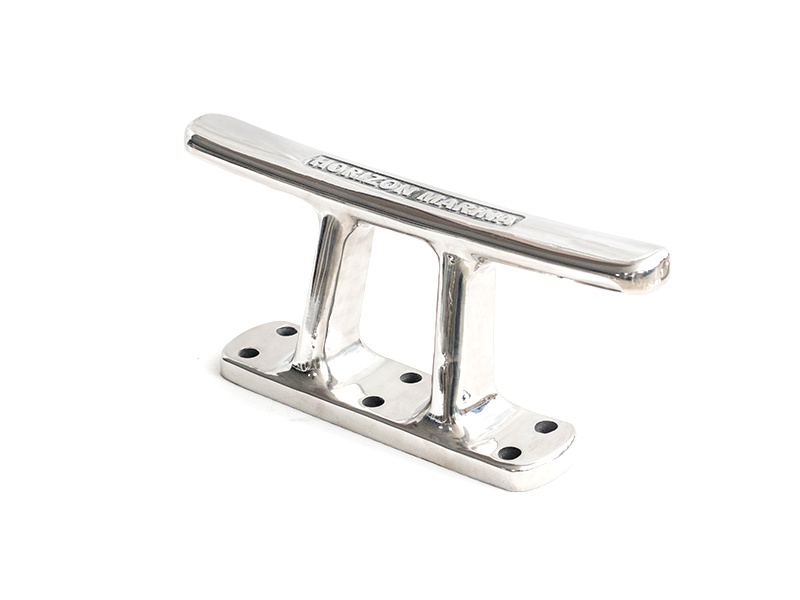
Selecting the right dock cleat is a mathematical process. It requires balancing vessel length, displacement weight, and the physical diameter of the ropes.
The marine industry relies on a standard metric for initial sizing. You need at least 1 inch of hardware length for every 10 feet of boat length, plus a foundational starting size. A 30-foot boat typically requires at least a 9-inch or 10-inch fitting to safely accommodate the necessary lines.
To simplify the selection process, refer to the sizing matrix below. Keep in mind that this is a minimum requirement baseline for standard, protected conditions.
Vessel Length (Feet) | Minimum Hardware Length | Recommended Mooring Line Diameter |
|---|---|---|
Up to 20 ft | 6 to 8 inches | 3/8 inch |
21 to 30 ft | 8 to 10 inches | 1/2 inch |
31 to 40 ft | 10 to 12 inches | 5/8 inch |
41 to 50 ft | 12 to 15 inches | 3/4 inch |
50+ ft | 15+ inches (Bollards) | 7/8 inch to 1 inch+ |
Length alone does not tell the whole story. Hull design and overall displacement play massive roles in hardware selection. Consider two 35-foot boats. One is a sleek racing sailboat. The other is a heavy-displacement trawler with a tall flybridge.
The racing sailboat might displace only 8,000 lbs and feature a low profile that slices through the wind. In contrast, the trawler may displace 25,000 lbs and act like a massive sail. Despite sharing the same overall length, the trawler possesses significantly more kinetic energy. Consequently, it requires a much higher-rated anchor point. Always adjust your sizing upward if your vessel falls into a heavy displacement category.
An anchor point is only functional if it can properly secure the necessary lines. Specifically, the gap under the horns and the base width must comfortably accommodate the diameter of your ropes. A properly tied hitch requires a full wrap around the base, followed by tight figure-eight turns, and a locking half-hitch.
If the horns are too small, the rope will jam or chafe. This prevents a secure hitch and increases the risk of the line slipping off under tension. Verify that your chosen hardware explicitly supports your specific line diameter without overcrowding.
Different docking scenarios demand different structural geometries. Modern systems come in various configurations, each engineered to handle specific load directions and operational environments.
The traditional two-horn design remains the most ubiquitous style. It offers excellent space for complex line tying and works effectively for bow, stern, and spring line applications. However, traditional upward-protruding horns create significant tripping hazards on high-traffic commercial piers.
To mitigate pedestrian injuries, engineers developed flat top designs. These maintain the necessary load limit and under-horn clearance but feature a flattened upper profile. They sit closer to the deck, keeping the surface safer without compromising structural holding power.
For high-tonnage yachts and commercial fishing vessels, standard twin-horn designs often lack the required vertical holding capacity. Bollard cross cleats are the preferred alternative.
Featuring a thick primary post intersected by a horizontal crossbar, this robust geometry allows for multi-directional line tying. It excels at handling steep upward pull angles. The vertical post efficiently distributes heavy shear loads straight down into the dock substructure.
Retractable models sit flush with the decking when not in use. They are highly favored for their sleek aesthetic and safety benefits on residential swim platforms.
While incredibly convenient, buyers must exercise caution. Moving parts inherently introduce mechanical weak points. Folding mechanisms rely on hinges, meaning their overall holding power can sometimes be lower than that of a solid cast unit. Reserve these primarily for smaller vessels or temporary tie-ups.
The metallurgical composition of your hardware dictates its lifespan and yield strength. Selecting the wrong material guarantees premature failure.
For saltwater environments, 316 stainless steel is the undisputed premium standard. Unlike standard 304 stainless, the 316 alloy contains molybdenum, drastically increasing its resistance to salt pitting. A cast 316 stainless steel fitting provides an exceptional balance of massive tensile strength and longevity.
Cast aluminum is lightweight, naturally rust-proof, and highly durable when properly alloyed. High-grade aluminum Mooring Cleats are widely used in premium marina pontoon systems. They offer excellent shear strength and can be anodized for extra protection. However, you must install them using proper isolation techniques—like nylon washers—to prevent galvanic corrosion when paired with stainless steel fasteners.
When raw, unyielding strength is the primary objective, hot-dipped galvanized steel is the optimal choice. Forged from heavy-duty iron or steel, these units are coated in molten zinc. The zinc acts as a sacrificial anode to prevent the underlying metal from rusting. Galvanized hardware resists the abrasive chafing of heavy nylon ropes, making it the go-to material for commercial ports.
Even the strongest anchor point is ineffective if positioned incorrectly. Proper geometry dictates how effectively the lines can stabilize the vessel.
A frequent question in marine engineering revolves around proper spacing. The established industry practice is to space anchor points at intervals roughly equal to the length of the shortest boat that will regularly use the slip. For general-purpose marinas, installing a tie-down point every 10 to 15 feet provides maximum flexibility.
A secure vessel requires a minimum of four opposing lines. Bow and stern lines keep the boat parallel to the dock. They should attach to points slightly forward of the bow and aft of the stern to create optimal 45-degree holding angles.
Furthermore, spring lines are arguably the most critical. They absorb forward and aft surging caused by wakes and wind. Hardware must sit near the midship of the vessel to allow these lines to run at shallow, diagonal angles. A steep spring line angle drastically reduces its shock-absorbing ability.
The ultimate failure point in a mooring system is rarely the metal itself. It is almost always a flawed installation method. A 10,000 lb anchor screwed into a rotting piece of pine has a functional holding power of exactly zero.
Never use lag screws driven directly into wooden deck planks to secure load-bearing hardware. Over time, moisture and dynamic shock loads compress the wood fibers, causing the threads to strip. This inevitably results in a sudden pull-out failure.
Through-bolting is a mandatory engineering practice. Drill completely through the decking and underlying structural joists. Pass a marine-grade hex bolt through the assembly, and secure it from the bottom with a nylon-insert lock nut. This shifts the load from the weak friction of wood threads to the immense shear strength of the steel bolt.
Even with through-bolting, intense upward forces can cause washers and nuts to crush straight through the bottom of soft wooden boards. To prevent this, robust backing plates are required.
Place a wide piece of heavy aluminum or stainless steel underneath the dock structure. The mounting bolts pass through the top hardware, the deck, and the backing plate. This dramatically increases the surface area over which the load is distributed. The dock itself would have to break before the hardware pulls free.
Standard sizing guidelines are based on average, protected conditions. However, shifting environmental factors require a proactive approach to upgrading your infrastructure.
Recent coastal engineering data reveals a distinct shift in marina development. Operators are moving away from baseline minimum compliance and embracing over-engineering. Due to the increasing frequency of severe weather events, unpredictable tidal surges, and the growing average size of recreational vessels, standard hardware sizing is often no longer sufficient. Modern floating dock systems now routinely integrate heavy-duty commercial-grade tie-downs into residential and light-commercial marinas. Sizing up is no longer just for mega-yachts. It has become the standard best practice to future-proof waterfront investments.
If your slip is located on open water with a long fetch, it experiences relentless dynamic drag. In these turbulent environments, empirical data suggests sizing up your hardware by at least one or two tiers. A 30-foot boat in a high-current river should upgrade from a 10-inch standard unit to a 12-inch or 15-inch heavy-duty model to handle the continuous strain.
During severe weather events, water levels surge and wind speeds can quadruple the dynamic forces exerted on a dock. Emergency docking protocols require double lines and thick chafe gear. This inherently demands oversized horns to accommodate the extra bulk. Upgrading your primary load-bearing points and reinforcing the backing plates before storm season is the most cost-effective insurance policy available.
A vessel is only as safe as the hardware tethering it to the land. Matching the load rating, physical size, and metallurgical composition of your equipment to your specific boat is a non-negotiable aspect of marine safety.
Take the time to inspect your current infrastructure. Look for hairline stress cracks, rust bleeding from base plates, or inadequate sizing that crams your ropes. If your setup falls short, do not wait for a storm to expose the weak link. Explore premium, properly sized dock hardware today. For reliable, engineered solutions that stand up to the harshest marine environments, upgrading to high-quality Horizon Marina equipment ensures your peace of mind and protects your maritime investments.
The bolt diameter directly depends on the pre-drilled hole size of your specific hardware. Typically, 8-inch to 10-inch models require 3/8-inch bolts, while 12-inch and larger models demand 1/2-inch or 5/8-inch bolts. Always use marine-grade 316 stainless steel hex bolts that are long enough to pass through the deck board, the structural stringer, and a thick backing plate, leaving enough thread for a nylon-insert lock nut.
Composite decking lacks the structural grain strength of solid wood. You must never mount load-bearing hardware directly to composite boards alone. Drill through the composite board and directly into the underlying wooden or aluminum structural frame of the dock. A heavy-duty backing plate underneath the frame is absolutely essential to prevent the composite material from cracking or warping under upward pressure.
Structurally, no, but practically, yes. If the horns are massively oversized, your smaller mooring lines might not grip the metal properly. This lack of friction can lead to the lines slipping off under varying tension. It is always best to match the dimensions to the specific line diameter required for your vessel.
Visual inspections are critical. Look for hairline cracks in the metal, particularly around the base and the neck of the horns. Rust bleeding from the base indicates failing bolts. Furthermore, loose bolts or rotting wood around the installation site are immediate red flags that the mounting structure is severely compromised.
High-grade, anodized cast aluminum is exceptionally strong, lightweight, and resists corrosion well. It is an excellent choice for floating pontoon docks. However, it does not match the raw tensile strength of heavy steel alloys. 316 stainless steel or hot-dipped galvanized steel provides vastly superior load ratings, making them the required choice for high-tonnage commercial vessels.
Always use marine-grade 316 stainless steel bolts to prevent rust. Pair these with nylon-insert lock nuts to prevent loosening from vibration, wide fender washers, and a structural backing plate. This combination prevents galvanic corrosion when properly isolated and ensures maximum pull-out strength under dynamic shock loads.